
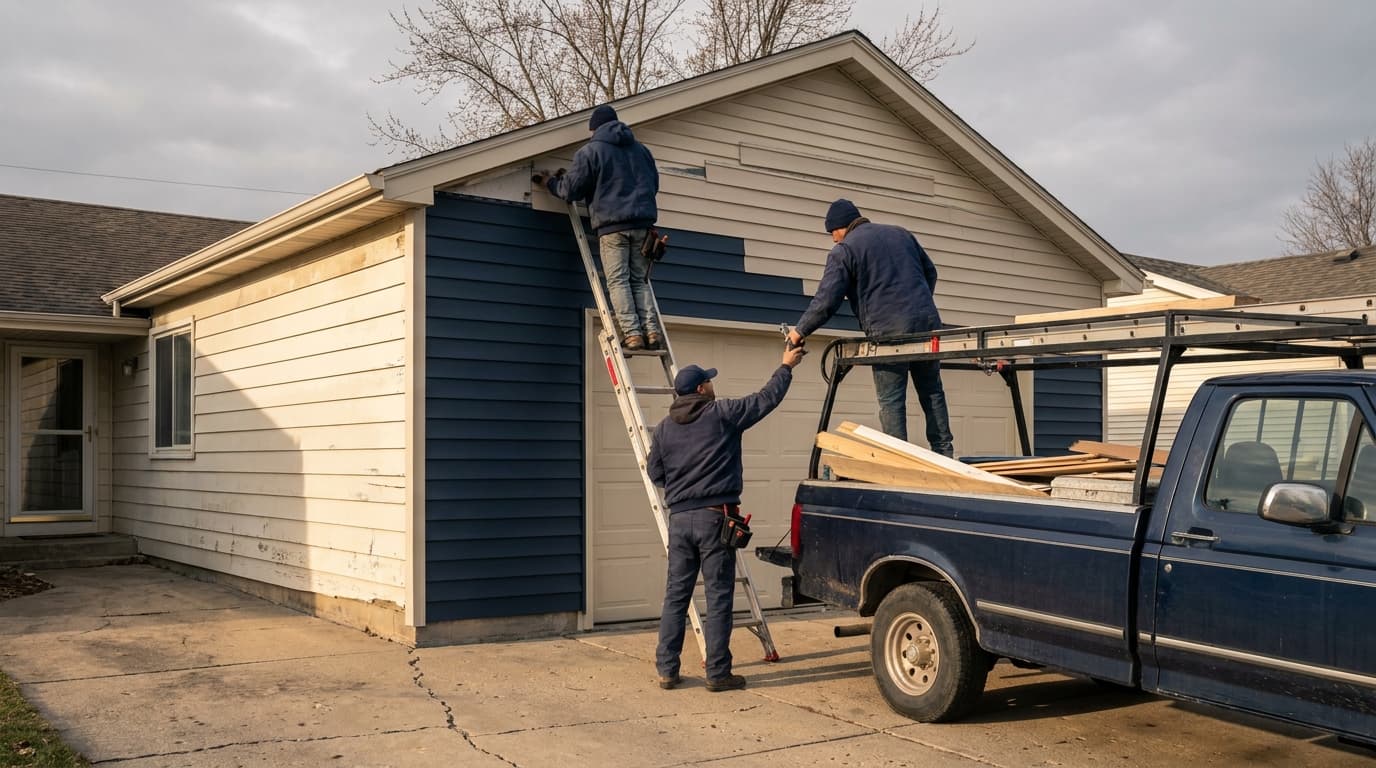
Franchise category
Home Improvement Franchises in the USA: A Buyer's Guide
Every homeowner eventually needs a repair, a remodel, or a repaint. So why does one franchise territory thrive while the one next door struggles? The answer lies in the document most buyers never read closely enough.
Why Home Improvement Is Pulling Investor Attention Right Now
Homes age. Roofs leak, kitchens go out of style, foundations settle, and paint fades. That basic fact doesn't disappear when interest rates rise or the stock market wobbles. It's part of why the home improvement category, covering interior work, exterior work, property services, renovations, and repairs, keeps drawing new franchise owners even in uneven economic stretches. People defer big discretionary purchases before they defer a roof repair after a storm.
The category is also wide. It spans everything from small handyman-style repair calls to full exterior renovation projects, from one-person crews to multi-crew operations running several jobs at once. That range matters for an investor, because it means the segment isn't one business model wearing different logos. It's several different businesses that happen to share a common client base: homeowners and property managers who need work done and don't want to do it themselves.
Home improvement franchises tend to make sense for investors who want a business rooted in a tangible service, not a storefront dependent on foot traffic. Many of these concepts also lend themselves to lower up-front real estate costs, since the work happens at the customer's property rather than in a retail space the franchisee has to build out and staff. That combination of real, recurring demand and a leaner physical footprint is a big part of the appeal.

How the Model Actually Works, Per the FDD
Every legitimate franchise opportunity in this space is sold under a Franchise Disclosure Document, or FDD, the federally mandated file every franchisor must hand a prospective buyer before any money changes hands. It's not marketing copy. It's a disclosure document, and in home improvement it typically spells out four things every buyer needs to understand cold.
First, the initial franchise fee, the upfront payment for the right to operate under the brand and system. Second, the royalty structure, the ongoing percentage of revenue paid back to the franchisor, usually collected weekly or monthly, which funds the systems, national marketing, and support the franchisor is supposed to keep delivering. Third, territory, the geographic area the franchisee is granted, often defined by population count or a mapped radius rather than a simple zip code, since in a service-based category the addressable market is really the number of homes and businesses inside that boundary. Fourth, training and support, the onboarding process and the ongoing coaching a franchisor provides on estimating jobs, managing crews, and running the back office.
A well-run home improvement franchise system also typically supplies proprietary tools: estimating software, vendor relationships for materials, lead generation support, and a playbook for pricing jobs consistently. None of that replaces the franchisee's own work ethic, but it's the difference between reinventing the wheel and following a system that's already been tested across other territories.
What a Week Actually Looks Like for the Owner
This is where home improvement franchises split into two very different owner experiences, and it's worth knowing which one you're signing up for before you sign anything.
Some concepts in this category are built for an owner-operator: someone who's out on estimates in the morning, on a job site by midday, and handling invoicing or supplier calls in the evening. It's hands-on, physical at times, and rewarding for someone who likes seeing tangible results by the end of the week.
Other concepts, particularly those with multi-crew or project-management models, are built for a semi-absentee or executive-owner structure. In that version, the franchisee hires and manages crews, handles sales calls and estimates or oversees someone who does, and spends more time running the business than swinging a hammer. Many investors coming from a corporate background gravitate toward this version, because it draws on management and sales skills rather than trade skills.
Either way, a typical week involves some mix of estimating new jobs, scheduling crews, following up with customers, managing materials and vendors, and reviewing numbers. The specific ratio of field time to office time depends entirely on the concept, and it's exactly the kind of detail that should get clarified before signing, not after.
What to Evaluate Before Choosing a Brand
Not every home improvement franchise is built the same, and the FDD is where the real differences show up, not the sales pitch.
Start with territory definition. Ask whether it's protected, how it's sized, and whether the boundary actually matches enough homes to support the business plan. Then look at the fee and royalty structure together, not separately, since a lower franchise fee paired with a high royalty can cost more over time than the reverse. Training and support deserve scrutiny too: does the franchisor provide field visits after launch, or is initial training the extent of it? And pay close attention to franchisee turnover, meaning how many franchisees have left the system and why, since a document with a stable, low-turnover franchisee base tells a very different story than one with heavy churn.
This is precisely the analysis TFG runs for every investor before a recommendation ever gets made. As a member of the Franchise Brokers Association and holder of the Franchise Sales Compliance designation, TFG reviews the FDD line by line across its full catalog of vetted brands, comparing fee structures, territory models, and support commitments side by side. That review, and the guidance that comes with it, is provided to investors at no extra cost, since compensation comes from the franchise system itself, standard practice in the brokerage industry.
Investment-Based Immigration and This Category
For international investors, home improvement franchises often come up in conversations about the E-2 visa, a category for nationals of treaty countries making a substantial investment in a US business they'll actively direct and develop. The active, hands-on nature of many owner-operator models in this space can align well with E-2 requirements, since the visa generally expects the investor to be running the business, not sitting passively on the sidelines.
For investors considering the EB-5 path, which involves a larger investment tied to job creation rather than active management, some larger multi-unit or multi-territory home improvement structures may be worth exploring, though the fit depends heavily on the specific concept and investment structure. Either route requires case-by-case evaluation, and no franchise consultant can promise a visa outcome. That determination always rests with a licensed immigration attorney, which is why TFG works alongside immigration counsel as a standing part of its process rather than treating the visa question as an afterthought.
Where This Leads
Reading about the category is step zero. The real next step is figuring out where you fit inside it: which sub-segment matches your budget, your appetite for fieldwork versus management, and your visa timeline, if there is one. TFG's free diagnostic is built to answer exactly that. It maps your profile, your available capital, and your potential visa route in a matter of minutes, and it becomes the working foundation for the first real conversation with a TFG consultant. That's the actual starting point of the process, not a quiz you take and forget.
Start the process with your free diagnostic
It is the first formal step of the TFG process: a few minutes of questions map your capital, your timeline, and your possible route. Your consultant receives everything before the first conversation.
Start my free diagnosticFrequently asked questions
- How much does it cost to open a home improvement franchise?
- It varies widely by concept, since this category spans everything from small repair-service businesses to larger renovation operations. Every franchisor discloses its exact initial franchise fee, estimated startup costs, and ongoing royalty structure in the FDD, which is the document to review closely before comparing any two opportunities.
- Do I need construction or trade experience to own a home improvement franchise?
- Not necessarily. Many systems in this category are built around owners who manage crews, sales, and operations rather than performing the trade work themselves, while other models are more hands-on for owners who prefer fieldwork. The right fit depends on the specific brand's operating model.
- Are home improvement franchises considered recession-resistant?
- Home repairs and maintenance tend to stay necessary regardless of economic cycles, since homeowners generally can't indefinitely postpone issues like a leaking roof or a failing system. That said, no business is immune to downturns, and demand levels still vary by sub-segment and local market.
- What's the difference between owner-operator and semi-absentee models in this space?
- Owner-operator models have the franchisee actively working in the field, estimating and often performing jobs. Semi-absentee or executive models have the franchisee managing crews, sales, and operations while spending less time doing the physical work directly. Both exist within home improvement, and the FDD and franchisor training program usually make clear which structure a given brand expects.
- Can a home improvement franchise support an E-2 or EB-5 visa application?
- Some can, particularly owner-operator models that require the investor to actively direct daily operations, which aligns with common E-2 expectations. Whether a specific concept and investment level qualifies for E-2 or EB-5 always needs case-by-case review by a licensed immigration attorney.
- How do I know if a home improvement franchise territory is any good?
- Look at how the franchisor defines and protects the territory in the FDD, whether it's based on population, household count, or a mapped radius, and whether that area realistically supports the revenue goals in your business plan. A vague or overlapping territory definition is a red flag worth raising before signing anything.
From the blog on this category
All articles →


Your next step has a name: diagnostic.
Answer the 2-minute questionnaire and receive your preliminary diagnostic on the spot. It is the same document that opens your conversation with a TFG specialist.
Educational content about the segment. It is not an offer of a specific franchise, financial advice, or legal advice. A franchise offer is made only by the franchisor, through the official disclosure document. Visa paths are always evaluated by licensed immigration attorneys.